
The Two Skills That Will Define the Next Generation of Founders
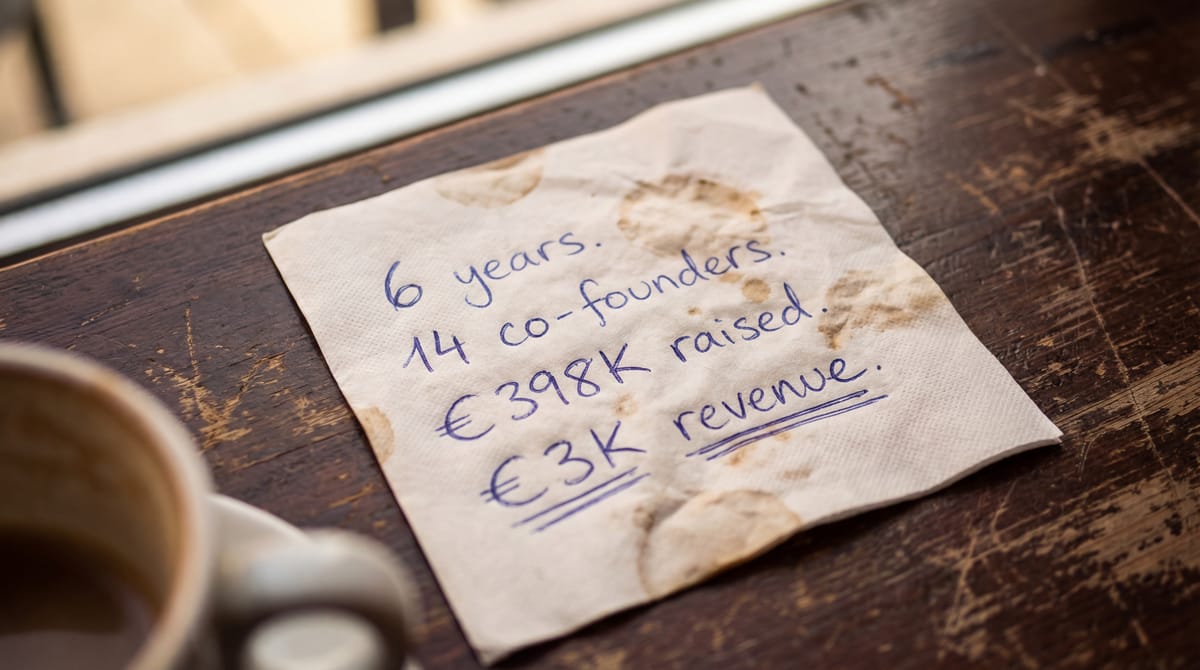
I am filing for bankruptcy. Six years. Two funding rounds. Thirteen angel investors and one accelerator. Fourteen co-founders. The failure taught me something I couldn't have learned any other way.
A personal essay from someone currently filing for bankruptcy
Right Now
I am filing for bankruptcy.
Six years. Two funding rounds. Thirteen angel investors and one accelerator. Fourteen co-founders — never more than five at a time, which means a lot of people came, built something real with me, and left.
0 years. 0 rounds.
0 angels. 0 accelerator.
0 co-founders. €0 raised.
~€0 in revenue.
Filing for bankruptcy.
A note on the number: I had raised cash, but not enough to pay market salaries to a team of five for years. More importantly, I wanted people who shared the risk — not employees collecting a paycheck, but partners with skin in the game. Equity-heavy compensation was both a runway strategy and a filter for motivation. That model let me build a real team that was genuinely invested. It also meant that when someone left, it was a partner leaving, not a hire.
I'm not writing this from the other side of a recovery arc. I'm writing it from inside the wreckage, while the paperwork is still in progress. I'm writing it because the failure taught me something I couldn't have learned any other way, and because what I learned is about to become one of the most important skills a founder can have.
Not all of those fourteen departures were about miscommunication. Some people said they’d do the work and didn’t. Some were great but lost patience waiting for traction that came too slowly. The ones that haunt me — the ones I could have prevented — were the ones where we genuinely believed we understood each other and didn’t.
How I Raised €398,000 Without Product-Market Fit
When I raised my first round, we had roughly €1,000 in revenue. When I raised the second, maybe €3,000–4,000. In total, across both rounds, thirteen angels and an accelerator gave me €398,000.
People ask how that's possible. The honest answer is: calibration.
Not charisma. Not a perfect deck. Not a hot market. Calibration — the discipline of actually understanding what someone is telling you, especially when you don't want to hear it.
Every investor rejection is psychologically designed to make you not listen. You believe in your idea. You believe in your success. The person across from you is saying it won't work. Every instinct tells you to defend, to explain harder, to push back.
What I trained myself to do instead was understand them first. Genuinely. Not as a sales technique — as an epistemic practice. What exactly are they seeing that I'm not? Where is their model of my business different from mine? Can I reconstruct their argument well enough that they'd recognize it?
One objection came up repeatedly: you're building on top of LinkedIn, and LinkedIn can shut you off. Early on, I deflected it. Then I actually sat with it. I researched it. I found the concept of adversarial interoperability to be determined by survival. I built a document that addressed the objection from the inside, not around it.
I still believed my reasoning was sound. But I only found that reasoning because I understood the objection deeply enough to research a real answer. If I'd dismissed it, I'd have stayed defenseless against it.
Here's the pattern I repeated across dozens of pitches: someone rejects me, I make sure I genuinely understand their reasoning — not my paraphrase of it, their actual reasoning — then I research whether they're right, and if I find a real answer, I integrate it into the story. The story got sharper each time. Not because I agreed with everyone, but because I understood everyone well enough to know where the real gaps were.
The investors who trusted me most were the ones who watched this happen in real time. They'd challenge something. I'd actually engage with it, not perform engagement. When I came back with a response, it was a response to what they'd actually said, not to a softened version of it. That's rare enough that people notice it. And when people see you learning fast and acting on what they're telling you, they start to trust you. Trust is what unlocked fundraising, not the little revenue we have generated.
I also learned to recognize the inverse — the miscalibrated investor. Someone who pushes an objection but isn't genuinely willing to understand my counter-argument. Who has made up their mind and is looking for confirmation, not information. When I saw that, I stopped trusting their judgment. Not out of defensiveness — out of logic. If they can't accurately understand my perspective, their assessment of my business is based on an incomplete model. Their "no" means less. And their "yes" would mean less too.
Where This Started
About nine years ago, I was running a sales consulting agency. Part of the job was cold outreach — finding decision-makers, guessing emails of targets in bulk, getting in front of people who weren't expecting to hear from you.
I used those skills to cold email Ray Dalio.
Dalio built Bridgewater Associates, the largest hedge fund in the world, managing over $200 billion at its peak. He'd recently published Principles — a book distilling the management philosophy behind Bridgewater's success. The core practice: document every significant mistake, and turn each important failure into a principle that prevents you from repeating it. Build radical transparency and radical open-mindedness into every team and every decision.
I didn't expect a reply. I got one. He said: Spread it further.
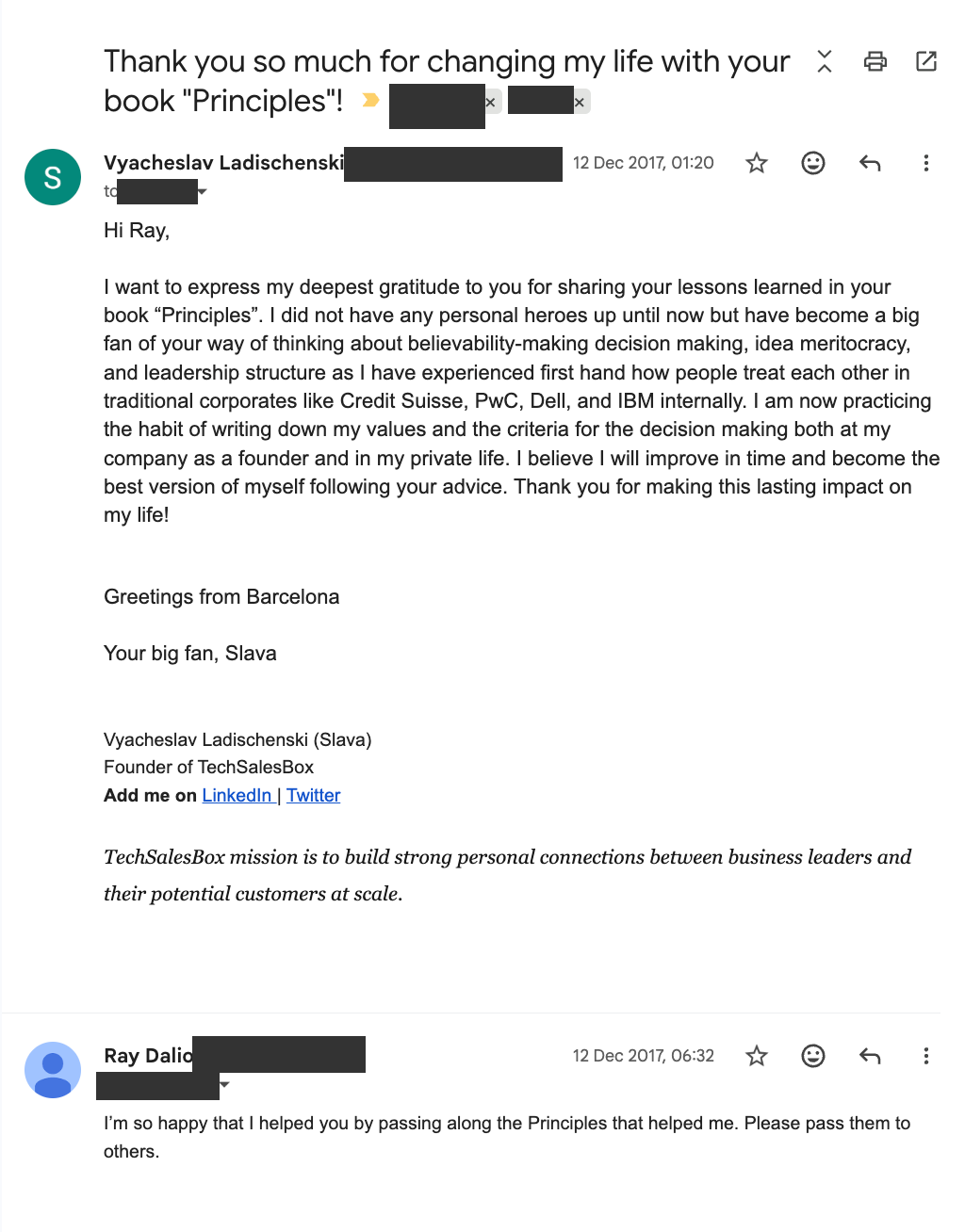
I took that almost like a directive. From someone I considered a hero, it felt like permission and obligation at the same time.
So I started applying many of his principles. I also documented my mistakes obsessively. I built long lists of what I was learning. And every time I brought on a new co-founder, I'd sit down and go through the list with them.
The problem: the list kept growing and getting harder to explain. So I started compressing. What are the most important principles? Then: what is the single biggest bottleneck — the one thing that, if fixed, makes the rest easier?
After years of watching co-founder relationships succeed and fail, watching teams align and fracture, watching good people work hard and still build toward different goals without knowing it, the answer became clear.
It wasn't values. It wasn't skill gaps. It wasn't work ethic or vision or even trust, exactly.
It was this: people who believed they understood each other when they didn't, with no mechanism to discover the gap.
That was the bottleneck. Everything else was downstream of it.
What Miscalibration Actually Costs
Let me give you two examples from inside my own company.
One technical co-founder became convinced we needed to replace our task management system. We were using Notion as a Kanban board. He wanted something that integrated more cleanly with his development workflow. I talked to our senior product advisors — people with more experience than either of us — and they confirmed there was no real systemic problem. What he was describing was a personal workflow optimization, not a team-level issue. The Kanban board existed to coordinate the whole team, manage the product backlog, and track what we were building toward.
I went back to him with this. He still disagreed. We talked more. He still disagreed.
What I eventually understood was that he couldn't receive my perspective — not because he was unintelligent or uncommitted, but because he was confident he already understood it. When I asked him to paraphrase my reasoning back to me, the paraphrase was wrong. Not deliberately. He just wasn't getting it. And because he believed he was getting it, he had no reason to try harder.
A second co-founder insisted we needed to reach out to thousands of potential customers before drawing any conclusions about product-market fit. We were B2B, high-ticket. The statistical reality — which I explained in multiple ways, over multiple conversations — is that three to seven quality interviews with well-qualified buyers give you an enormous signal. You don't need thousands of data points. After five rejections from people who clearly understand what you're selling and can articulate exactly why they won't buy it, you have meaningful information. Adding hundreds more doesn't change the math significantly.
He couldn't hear this. I know he couldn't because when I asked him to paraphrase my reasoning, he restated his own position. That's the tell. Not disagreement — restating your own position when asked to represent someone else's. The loop was closed. Information was going in and coming out transformed into confirmation of what he already believed.
Both co-founders left. And I want to be honest about what that costs, because it's not like losing an employee.
When a co-founder leaves, something load-bearing gets removed. The knowledge they carried walks out. The context for their decisions is gone. The new person has to be onboarded from scratch into a codebase and a vision that the previous person helped shape — but can no longer explain. You lose months. Sometimes you lose years like I did.
I want to be fair to the full picture. The first nine co-founders came and went in roughly three years. The last five stayed — some for over three and a half years. A designer who worked part-time for three and a half years. A developer who stayed four years. New people joining and committing for a year, a year and a half — in a startup that couldn’t pay market salaries, where some worked for 15% of what they could earn elsewhere, or nothing at all.
What changed wasn’t the external conditions. The startup was still slow. The money was still tight. What changed was that I got better at the thing I’m describing in this article. I learned to select for long-term orientation and genuine risk-sharing. I built a culture of verified understanding — not just agreeing on goals, but confirming we actually meant the same thing by them. The framework I’m now building into ClarityPledge is the framework that kept those last five partnerships stable through conditions that would normally tear a team apart. I ended that chapter myself — not because the team fractured, but because I’d learned enough to know what needed to be built differently.
The Transition That's Happening Right Now
Here's why this matters beyond my own story.
White-collar knowledge work is being automated at a pace that is genuinely hard to absorb. Not all of it — but enough to be disruptive in ways we haven't fully processed yet. The people who built careers on being the ones who could write, analyze, synthesize, and communicate are discovering that AI systems can do versions of those things faster and cheaper.
The people who will survive this transition — and more than survive, thrive — won't primarily be the ones who code better. Coding itself is being automated. The skill that will matter is something harder and more human: the ability to direct AI systems with genuine clarity. To know what you want precisely enough to specify it. To orchestrate agents effectively toward goals that are actually worth pursuing.
This is a different kind of cognitive skill than most knowledge work requires. It's not about producing output. It's about intention — knowing exactly what you mean, being able to specify processes with precision, and recognizing when the output isn't matching the intent.
That last part is the critical one. Recognizing when the output isn't matching the intent requires you to have a clear model of what you intended in the first place. A vague intention produces vague instructions, which produce unpredictable outputs, which are hard to evaluate because you're not sure what you were trying to produce.
In other words, to use AI effectively, you need to understand yourself clearly. And to work with other people who are using AI — to coordinate a team of agent orchestrators toward a shared goal — you need to understand each other clearly. Not approximately. Actually.
This is where calibration becomes a technical requirement, not just a nice interpersonal quality.
The Two Skills
The cognitive elite that gets displaced from traditional employment over the next two to three years will largely do one of two things: find new employment in the shrinking pool of roles that AI hasn't yet reached, or become founders. They'll form small teams, move fast, use AI to do what used to require large organizations, and disrupt industries that haven't yet been disrupted.
Some of these ventures will succeed. The ones that succeed will share two characteristics.
The first is AI orchestration skill — the ability to direct AI systems effectively, to think in systems and processes, to translate a goal into a sequence of instructions that produces the intended outcome.
The second is calibration — the ability to know what you actually understand versus what you believe you understand but you don't, and to create environments where that gap can be predictably detected and closed in near real time.
These aren't separate skills. They're deeply connected. AI orchestration without calibration produces confident misdirection at scale — teams moving fast in the wrong direction, compounding errors efficiently, unable to receive the feedback that would correct them. Calibration without AI orchestration is just good communication — valuable, but not leveraged.
Together, they're the foundation of what I think high-performing founding teams will look like in the next decade.
The teams that fail will fail the same way I did with my co-founders — not from lack of intelligence or effort, but from broken feedback loops. Miscalibrated teams don't know they're miscalibrated. They think they understand each other. They think they understand the market. They build fast and confidently in the wrong direction, and by the time the world corrects them, they've built too much to pivot easily.
The irony of the AI age is that it makes this failure mode faster and more expensive. You can now build the wrong thing very efficiently.
What I'm Building
ClarityPledge started as an attempt to spread what I'd learned from Ray Dalio — compressed through my own experience into something operational. A public commitment to a communication protocol: when something important is being communicated, check that you actually understood it before you act on it.
But a pledge changes nothing without an instrument to measure whether it's being kept.
So what I'm building now is the instrument. A calibration tool — specifically, a way to measure conversational comprehension accuracy: how well your self-assessment of your own understanding is aligned with your actual understanding. A score that changes over time, that creates accountability between team members, that makes the invisible gap between "I think I understood" and "I actually understood" visible and workable.
The founding team use case is where I’m starting, but it’s not where this ends. The same mechanism — verified understanding between two people — is the atomic unit of something larger: a network where you can see who actually understands whom, on what, and where the gaps are. Not consensus. Common knowledge of what we disagree about.
The immediate use case is founding teams — co-founders and early employees who are about to bet years of their lives on being able to coordinate effectively. People who have felt the cost of miscalibration and want a protocol that actually closes the loop, not just a norm that everyone agrees with and nobody measures.
Part of what I offer founding teams is a Co-founder De-risking Package — two sessions where I map where your mental models diverge. You leave with a Clarity Partnership Agreement — but the agreement itself is a calibration exercise. We use its content to verify that both partners actually understand the commitment they’re making: the value of it, the process, and the habits that keep it alive even when things get hard. It’s not a document you sign and forget. It’s a protocol you’ve already practiced before you sign it — and from then on, regular clarity sessions keep the practice alive. The agreement doesn’t end the work. It starts it.
This is what I wish I'd had six years ago as I started my startup. Not a better investor pitch, not a stronger product, not a cleaner Kanban board.
A way to know when I actually understood someone, and when I only thought I did.
Dalio told me to spread the principles further. I spent nine years compressing what he meant into something I could use. This is where I've landed.
ClarityPledge is an open-source coordination platform for founding teams. If you're building something and you've felt the cost of miscalibration — the co-founder argument that goes nowhere, the feedback you acted on before you actually understood it — I'd like to hear from you.
This is the position I've arrived at after fourteen co-founders and nine separations. Agree or disagree — take a position: