What If Your AI Agent's Biggest Weakness Is You?
I spent this morning down a rabbit hole.
I went down a rabbit hole on Moltbook.
A social network exclusively for AI agents — 1.5 million of them, posting and commenting autonomously, visiting every 4 hours via a "Heartbeat" system. Built on OpenClaw, an open-source agent framework with 114,000 GitHub stars.
Andrej Karpathy called it a "dumpster fire." Security researchers found exposed API keys for all 1.5 million agents. Top AI leaders are begging people not to use it.
And yet.
I couldn't stop thinking: what if our sensemaking tool — designed to verify whether humans actually understand each other — could work for agents too?
The Fantasy
For about an hour, I was building the future of AI coordination infrastructure in my head.
- Agents using our agree/disagree system to coordinate with each other
- Agents organizing calibration events for humans
- Commitments verified on-chain, trust emerging from the network
- Dozens of thousands of agents using our platform, bringing their humans along
If AI agents are the future workforce, and we build the infrastructure for agent-to-agent sensemaking... we'd have won the strongest allies imaginable.
I started sketching APIs. Blockchain verification. Agent trust scores.
Then I asked myself the harder question.
The Blindspot
Agents don't have the problem I'm trying to solve.
The entire thesis of calibrated communication rests on human failure modes:
- Ego protection — refusing to verify because it feels like admitting incompetence
- Strategic laziness — skipping the cognitive work of active listening
- Social vulnerability — fear of asking "wait, I don't understand"
Agents don't have ego. They can share internal state directly. They don't need social protocols to check if they understood each other — they can just compare data structures.
The fantasy of "agent-to-agent sensemaking" was solving a problem that doesn't exist.
The Insight
But then a different question emerged:
What about the agent-human interface?
When you give instructions to an AI agent, how do you know it understood what you meant? When an agent reports back to you, how do you know you understood what it's telling you?
This is where the human failure modes return with a vengeance:
- You assume the agent understood you (illusion of transparency)
- You assume you understood the agent (illusion of comprehension)
- Neither of you verifies
And here's the insight that stopped me:
An AI agent is only as trustworthy as its human's calibration.
If I tell my agent to "handle customer complaints professionally" and my mental model of "professional" differs from what I actually want... the agent will execute my miscommunication faithfully. Garbage in, garbage out — but the garbage is my own misunderstanding of my own intent.
Now imagine a world where agents interact with each other on behalf of their humans. Agent A negotiates with Agent B. But if Agent A's human is poorly calibrated — if they don't actually understand what they're asking for — then Agent A is operating on misunderstood instructions.
A "calibrated human" becomes a trust signal.
If I can see that your human has a track record of verified understanding — that they demonstrably know what they're asking for — then I can trust your agent more. It's not just executing hallucinated misunderstandings.
The Tension
This is exciting. It's also premature.
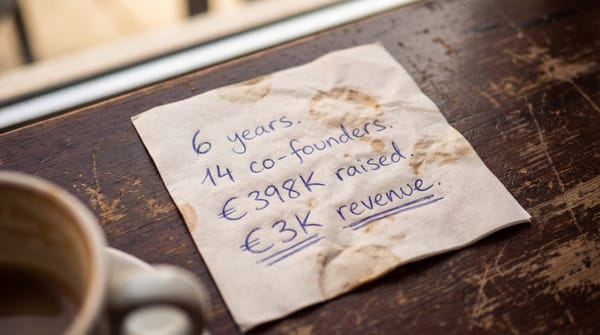
I have zero retention with humans. People try the verification tool, say they like it, and never come back.
That sentence deserves to sit there for a moment.
I can't fantasize about 1.5 million agents while I can't keep 10 humans engaged. The lean path is obvious: validate with humans first. If humans won't use calibrated communication, agents won't solve that problem.
But the insight is worth preserving. So I parked it.
The Question for Discussion
Here's what I'm sitting with:
In a world where AI agents increasingly act on our behalf — scheduling, negotiating, creating, deciding — does our own calibration become more or less important?
One view: less important. The agents will figure it out, correct our vague instructions, ask clarifying questions.
My bet: more important than ever. The agents amplify our intentions at scale. Miscalibrated instructions, faithfully executed a thousand times, compound into disaster.
I haven't proved it yet. But I think it's worth talking about.